The one-way valve: forward + reverse
A diode is a one-way valve for current. It conducts in one direction (forward) and blocks in the other (reverse). That single property — direction-dependent conduction — is the foundation of rectification, protection, voltage references, and more. The diode is the first active component in the Technical Ladder.
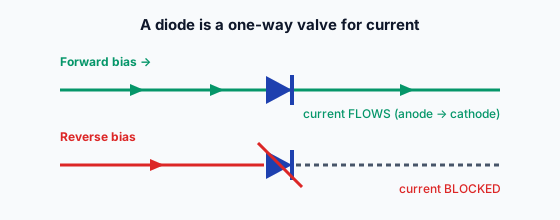
Forward and reverse
A diode has two terminals: the anode and the cathode (marked with a stripe on the physical part, the line on the schematic symbol).
- Forward biased (anode more positive than cathode): the diode conducts. Current flows anode → cathode.
- Reverse biased (cathode more positive than anode): the diode blocks. Almost no current flows.
This is the valve behaviour: push from the anode side and current flows; push from the cathode side and it's blocked.
The forward voltage drop
A diode isn't a perfect conductor even when forward-biased. It "costs" a forward voltage drop to push current through:
- Standard silicon diode: ~0.7V drop.
- Schottky diode: ~0.3V drop (lower).
- LED: ~1.8–3.3V depending on colour (an LED is a diode that emits light).
This drop matters in real circuits. A diode in series with a 5V supply leaves ~4.3V on the other side (5V − 0.7V). When you need to lose as little as possible (power circuits), you choose a low-drop Schottky.
Why "one-way valve" is so useful
The direction-dependent behaviour solves several practical problems:
-
Rectification. Converting AC (which alternates direction) to DC (one direction). A diode passes only the forward half of an AC wave, blocking the reverse — turning alternating current into pulsing DC, which a capacitor then smooths (L1's smoothing).
-
Reverse-polarity protection. A diode in series with a power input blocks current if the supply is connected backwards — protecting the circuit from a reversed battery. (A Schottky is often used here to minimize the voltage lost.)
-
Flyback / freewheeling protection. When you switch off an inductive load (a relay, motor), the inductor produces a high-voltage spike (L1's inductive kick). A diode placed across the load gives that spike a safe path, protecting the switching component. This is one of the most important practical uses — covered in detail on slide 1.3.
-
Voltage reference / clamping. A special diode (the Zener) conducts in reverse at a precise voltage, useful as a simple reference or over-voltage clamp.
The diode is "active" — sort of
The Technical Ladder calls diodes the first "active" component, though they're a bit of a bridge: a diode doesn't amplify or switch under external control (that's the transistor, later in this module). But unlike the passives (R, C, L), a diode's behaviour depends on the direction and magnitude of the voltage across it — it's nonlinear, doing different things in different conditions. That nonlinearity is what makes it more than a passive.
What you need to know about any diode
For any diode in a circuit:
- Its orientation — which way is the cathode (stripe). Get this wrong and the circuit doesn't work (or, for a flyback diode, can short the supply).
- Its forward voltage drop — how much it costs (0.7V silicon, 0.3V Schottky).
- Its type — standard, Schottky, Zener, LED — each with a specific use.
- Its ratings — max forward current, max reverse voltage. Exceed these and it fails.
The next slide covers the diode types in detail; the slide after covers the forward voltage drop and the all-important flyback diode.
Diode types: rectifier, Schottky, Zener, LED
Four diode types cover almost everything you'll use: the standard rectifier, the Schottky, the Zener, and the LED. Each exploits the one-way behaviour for a different job.
Standard rectifier diode
The workhorse (e.g., the 1N4001 series, the 1N4148 small-signal diode).
- Forward drop: ~0.7V.
- Use: general rectification, reverse-polarity protection, flyback protection, signal steering.
- Ratings to check: max forward current, max reverse voltage (the 1N4001 handles 1A, 50V; the 1N4007 handles 1A, 1000V).
This is your default diode for most jobs. When someone says "put a diode there," it's usually a standard rectifier unless a special property is needed.
Schottky diode
A lower-drop, faster diode.
- Forward drop: ~0.3V (much lower than silicon's 0.7V).
- Faster switching than standard diodes.
- Use: where the voltage drop matters (switching power supplies, low-loss reverse-polarity protection) or where speed matters (high-frequency rectification in DC-DC converters).
- Trade-off: higher reverse leakage current; generally lower reverse-voltage ratings than standard diodes.
Choose a Schottky when losing 0.7V is too much — for example, protecting a 3.3V circuit where every fraction of a volt counts, or in the high-frequency switching of a buck/boost converter.
Zener diode
The "backwards" diode — designed to conduct in reverse at a precise voltage.
- Forward: behaves like a normal diode.
- Reverse: blocks until the voltage reaches the Zener voltage (e.g., 3.3V, 5.1V, 12V), then conducts, holding that voltage.
- Use: simple voltage references, over-voltage clamping/protection. A 5.1V Zener across a signal clamps it to ~5.1V, protecting downstream parts from over-voltage.
The Zener exploits a controlled reverse breakdown — what would destroy a normal diode is, in a Zener, a designed, repeatable behaviour. Useful for cheap voltage regulation and protection, though dedicated regulator ICs are better for serious power.
LED (light-emitting diode)
A diode that emits light when forward-biased.
- Forward drop: depends on colour — red ~1.8V, green ~2.2V, blue/white ~3.0–3.3V.
- Needs a current-limit resistor (L1) — an LED doesn't limit its own current and will destroy itself without one.
- Use: indicators, displays, illumination, optocouplers.
- Polarity: like any diode, it only works one way (longer lead = anode = positive, usually).
You met the LED current-limit resistor calculation in L1. The LED is the most visible application of the diode's one-way behaviour — and a reminder that even an indicator LED is a diode following all the diode rules.
Other diodes you'll meet later
- Rectifier bridges (four diodes in a package for full-wave rectification).
- TVS diodes (transient voltage suppression — fast clamping for ESD/surge protection).
- Photodiodes (generate current from light — the reverse of an LED).
These come up in specific applications later in the ladder.
Choosing the right diode
The selection logic:
| Need | Diode |
|---|---|
| General rectification / protection | Standard silicon (1N4001 etc.) |
| Low voltage loss / fast switching | Schottky |
| Voltage reference / clamp | Zener (at the desired voltage) |
| Indicator / light | LED (with current-limit resistor) |
| Flyback across an inductive load | Standard silicon or Schottky |
And always check the ratings: the diode must handle your forward current and reverse voltage with margin.
The next slide covers the forward voltage drop in practice and the flyback diode — the protective diode you'll add to every motor, relay, and solenoid circuit.
To protect a transistor from the voltage spike when switching off a relay coil, you use:
Forward voltage drop + the flyback diode
Two practical diode facts deserve their own slide: how the forward voltage drop affects your circuits, and the flyback diode — the protective diode you'll add to every inductive load.
The forward voltage drop in practice
A forward-biased diode drops ~0.7V (silicon) or ~0.3V (Schottky). This isn't free — it has consequences:
It costs voltage. A diode in series with your signal or supply removes its forward drop. Feed 5V through a silicon diode and you get ~4.3V out. For reverse-polarity protection on a 3.3V circuit, that 0.7V loss might be unacceptable — hence the Schottky's 0.3V (or a MOSFET-based "ideal diode" for near-zero loss in critical cases).
It dissipates power. The diode dissipates P = V_forward × I. A diode carrying 1A at 0.7V dissipates 0.7W — enough to need a diode rated for that power, and possibly a heatsink. In high-current paths, the lower Schottky drop also means less wasted heat.
It's roughly constant. The ~0.7V drop is relatively independent of current (over a wide range), which is why diodes also serve as rough voltage references and level shifts. Two diodes in series ≈ 1.4V; useful occasionally as a crude reference.
The flyback diode — the protective diode
This is the diode use you'll apply most often, and the one whose absence destroys the most circuits.
The problem (from L1): an inductive load — a relay coil, a motor, a solenoid — resists changes in current. When you suddenly switch OFF the current (open the switch), the inductor's collapsing magnetic field produces a large voltage spike, sometimes hundreds of volts, as it tries to keep the current flowing. This spike (the "inductive kick" or "flyback") can easily destroy the transistor or microcontroller pin that was switching the load.
The fix: a flyback diode (also called a freewheeling or catch diode) placed across the inductive load. The diode is oriented so it's reverse-biased during normal operation (does nothing) but conducts the instant the coil voltage reverses (at switch-off), giving the inductive energy a safe path to circulate and dissipate harmlessly instead of spiking the transistor.
Wiring the flyback diode correctly
The orientation is critical:
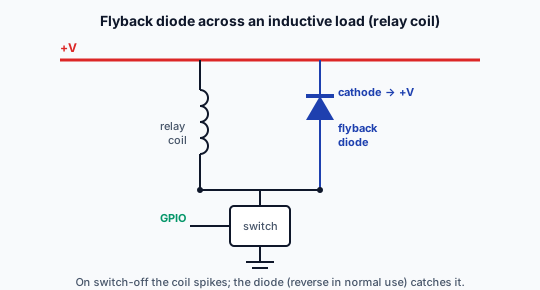
- Cathode (stripe) to the positive supply side of the coil.
- Anode to the switched (transistor) side of the coil.
In normal operation, the supply voltage reverse-biases the diode (cathode at +V, anode lower), so it's off. When the transistor switches off and the coil voltage flips (the switched side jumps high), the diode becomes forward-biased and conducts, clamping the spike to roughly +V + 0.7V instead of hundreds of volts.
Backwards is dangerous. If you install the flyback diode the wrong way round, it forward-conducts in normal operation — shorting the coil's supply through the diode, drawing huge current, and likely destroying the diode and possibly the supply. So: stripe to +V, every time.
The rule
Every inductive load switched by a transistor gets a flyback diode across it. No exceptions.
Relay? Flyback diode. Motor? Flyback diode (often a Schottky for speed). Solenoid? Flyback diode. The moment you're switching something with a coil, the flyback diode is mandatory. Forgetting it is one of the most common ways to destroy a transistor or fry a microcontroller pin.
Many relay modules and motor-driver boards include the flyback diode built in — but if you're wiring a bare coil to a bare transistor, you add it yourself.
Tying it to the transistor lessons
The flyback diode connects directly to the next lessons: when a transistor (or MOSFET) switches an inductive load, the flyback diode protects it. The transistor switch + the flyback diode together are the standard "microcontroller drives a motor/relay" circuit — which the P-Check and Lesson 3 build toward.
The next lesson moves to transistors themselves — the electronic switches that do the actual load-switching, with the diode protecting them.
A standard silicon diode's forward voltage drop is roughly: